
Baking Lazarakia: A Sweet Tradition for Lazarus Saturday
The tradition of making Lazarakia—small, sweet buns shaped like Lazarus—is a beloved Greek tradition observed on Lazarus Saturday, the day before Holy Week. It commemorates the miracle of Jesus raising Lazarus from the dead, as described in the Gospel of John (John 11:1–44), which took place just before Christ’s Passion. These buns, also known as Lazarus Buns, are shaped to resemble Lazarus wrapped in grave clothes, with his arms crossed, just as he is depicted in icons. The eyes are typically made from cloves or chocolate chips. Made with a lightly sweet, vegan dough, Lazarakia are a Lenten fasting food, and the tradition of baking them—especially with children—has become a cherished practice not only in Greece but among Orthodox Christian communities around the world.
In this blog post, I’ll share the recipe I use, how this feast is celebrated throughout the world, tips for baking with children, the meaning behind this tradition including the story, book recommendations, additional resources and how we celebrate this meaningful day as a community.
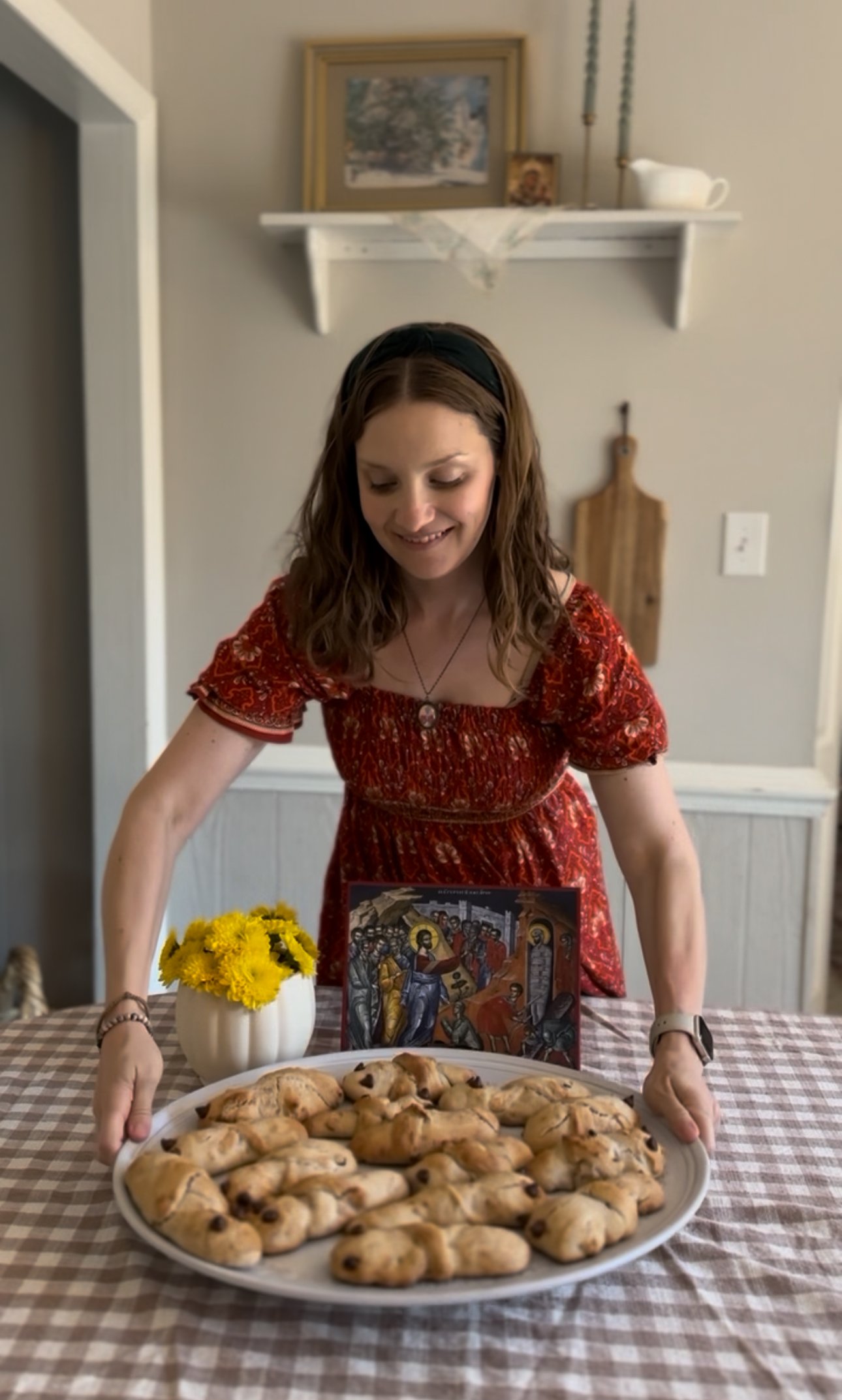
A Sweet Tradition For Lazarus Saturday
Lazarus Saturday is a very special day in mine and my husband’s life as it was the day we were baptized and received into the Orthodox Church back in 2012. I was first introduced to the tradition of baking Lazarakia on this day when the families with small children made them at Church to share. I was perplexed by these little mummy looking breads, and one of the children explained to me that they were shaped like Lazarus in grave clothes. I was delighted to eat one of these slightly sweet cinnamon breads! At the time we didn’t have children so I was more of an observer of feast day traditions. Then, several years later, while attending St Vladimir’s Seminary in New York, several of the moms got our kids together on Lazarus Saturday to make them. It was finally my turn to learn more about this tradition! My daughter at the time was 2, and she absolutely LOVED making them! They are very simple even for children to make and sometimes they come out quite frightening looking which is even better for the occasion! I absolutely love these delightfully frightening buns, as do all the children who make them! They are totally vegan and kid-friendly which makes them an ideal lenten fasting food. After making them together with friends, we were hooked! We have taken this tradition and observe it every year, determined to share it with others! If you’ve never made them before, I’d encourage you to give them a try!

What is Lazarakia?
Lazarakia (pronounced lah-zah-RAH-kia) are small, sweet, spiced buns traditionally baked on Lazarus Saturday, the Saturday before Palm Sunday. The name comes from “Lazarus,” the friend of Jesus who was raised from the dead, and these buns are made in his image—literally! They’re shaped to look like Lazarus wrapped in grave clothes, with little arms crossed over the chest, as seen in Orthodox icons. The eyes are often made with whole cloves or chocolate chips, and the dough is usually spiced with ingredients like cinnamon and cloves.
Lazarakia are also Lenten fasting-friendly, which means they’re vegan—no eggs or dairy—so they can be enjoyed during Great Lent. While the tradition originated in Greece, it has become a meaningful custom for many Orthodox Christian communities around the world, especially as a way to teach children the story of Lazarus in a hands-on, memorable way.

Image: Illumination Learning
Celebrated Around the World
Traditions in Greece: Various customs take place throughout Greece to commemorate this day. The most widespread custom for Lazarus of Saturday is the "carols of Lazarus" which reclaimed the joyous feast. The carols were exclusively almost female and were sung by girls of different ages, even married girls called “Lazarines”. On the eve of the feast, lazarines (girls) went out into the fields outside the villages to collect flowers that would be used to decorate their basket. The baskets were decorated with the flowers they collected and beautiful colorful ribbons. The next day dressed in local traditional costumes or a special costume, the girls carrying baskets full of Lazarakia and flowers went around the neighborhoods and sang Lazarus's carols and offered cookies. In return for this treat, they were given eggs, money, fruits or whatever else they had.
Traditions in America: After Divine Liturgy, many churches will have a family day with lawn games, fun activities for kids, and of course food! This day is often set aside to pour into the children in the community!
Lazarakia Recipe
Lazarakia are little sweet buns shaped like a man named Lazarus—a friend of Jesus who got very sick and died. But Jesus did something amazing: He brought Lazarus back to life! This miracle is remembered every year on Lazarus Saturday, the day before Palm Sunday. To celebrate, people make these special buns that look like Lazarus. They’re shaped like a little person wrapped in grave clothes (just like in the story), with arms crossed and clove eyes! Some people even use chocolate chips for the eyes instead—yum!
Lazarakia are made with a yummy dough flavored with cinnamon, orange, and spices. And guess what? They’re vegan, which means there’s no milk, eggs, or butter, so they’re perfect for Lent. Making Lazarakia is a fun way for kids and families to learn about this miracle, while spending time baking and celebrating together! You can find a recipe below.

Lazarakia "Lazarus" Buns
The Lazarakia or Lazarus Buns is a cherished feast day food tradition which are shaped and baked on Lazarus Saturday each year. They are shaped in the form of Lazarus in grave clothes with his arms crossed, as portrayed in the icons. The eyes are made of cloves (or chocolate chips). These special mummy shaped buns are made using a sweet dough and are a fasting Lenten food, meaning they are fully vegan. It is a cherished tradition, especially for children!
Ingredients
- 6-2/3 cups all purpose flour
- 3/4 cup avocado oil (or oil of choice)
- 1 cup sugar
- 2 packets active dry yeast
- 1-3/4 cups lukewarm water (and more as needed)
- 1 teaspoon cinnamon
- 1/4 tsp ground cloves (optional)
- 1 teaspoon salt
- Chocolate chips or cloves (for eyes)
Instructions
- Preheat the oven to 350°F. Line a couple of pans with parchment paper.
- In a mixer, add the yeast, little bit of sugar and lukewarm water. Whisk until the yeast and sugar dissolve and set it aside for 10 minutes to activate the yeast.
- Mix all the rest of the dough ingredients and then knead well, until the batter becomes a nice soft dough. You may need to add a little extra water, depending on the quality of the flour. Cover and let the dough rest for about 30 minutes in a warm place.
- Shape the Lazarus buns as an egg-sized amount of dough into an oblong shape. For the hands, form two little ropes of dough and place them in an x-shape across the middle of the oblong. Form a third little rope into a circle and place it on top of the oblong for the head. Stick two cloves or chocolate chips in the middle of the head for eyes.
- Place the Lazarakia on the baking sheets and let rise in a warm place until doubled in size, about 20 mins. Bake in a for 30-40 minutes, or until the bread rolls turn golden-brown.
Nutrition Facts
Calories
178Fat
10 gSat. Fat
1 gCarbs
21 gFiber
0 gNet carbs
20 gSugar
13 gProtein
1 gSodium
146 mgCholesterol
0 mgShort on time? Check out this Crescent Roll Version:

Crescent Roll Lazarakia by Draw Near Designs
If you need a quick version of these Lazarus buns, try making them with Crescent Rolls!
Lay out the sheet of crescent rolls and cut 3/4 of the roll into squares
Cut a 1/4 of that portion into little strips for the arms.
Optional: sprinkle cinnamon and sugar on the inside before rolling them up, and use chocolate chips for the eyes
Bake according to package directions
Watch us make Lazarakia in this reel on Instagram

Tips for Baking with Children
If you have a stand mixer, this will go a lot faster. Also this dough takes some time to pull together, so if you wanted to make the dough ahead of time, that would be ideal. The way I typically do this with my kids is make the dough ahead of time so that it is mixed and rested a bit to let the dough rise, and then I have my kids help shape them. This is the fun part for them. And my kids will watch the oven the entire time as they bake! They get so excited to see how their little mummy breads bake!
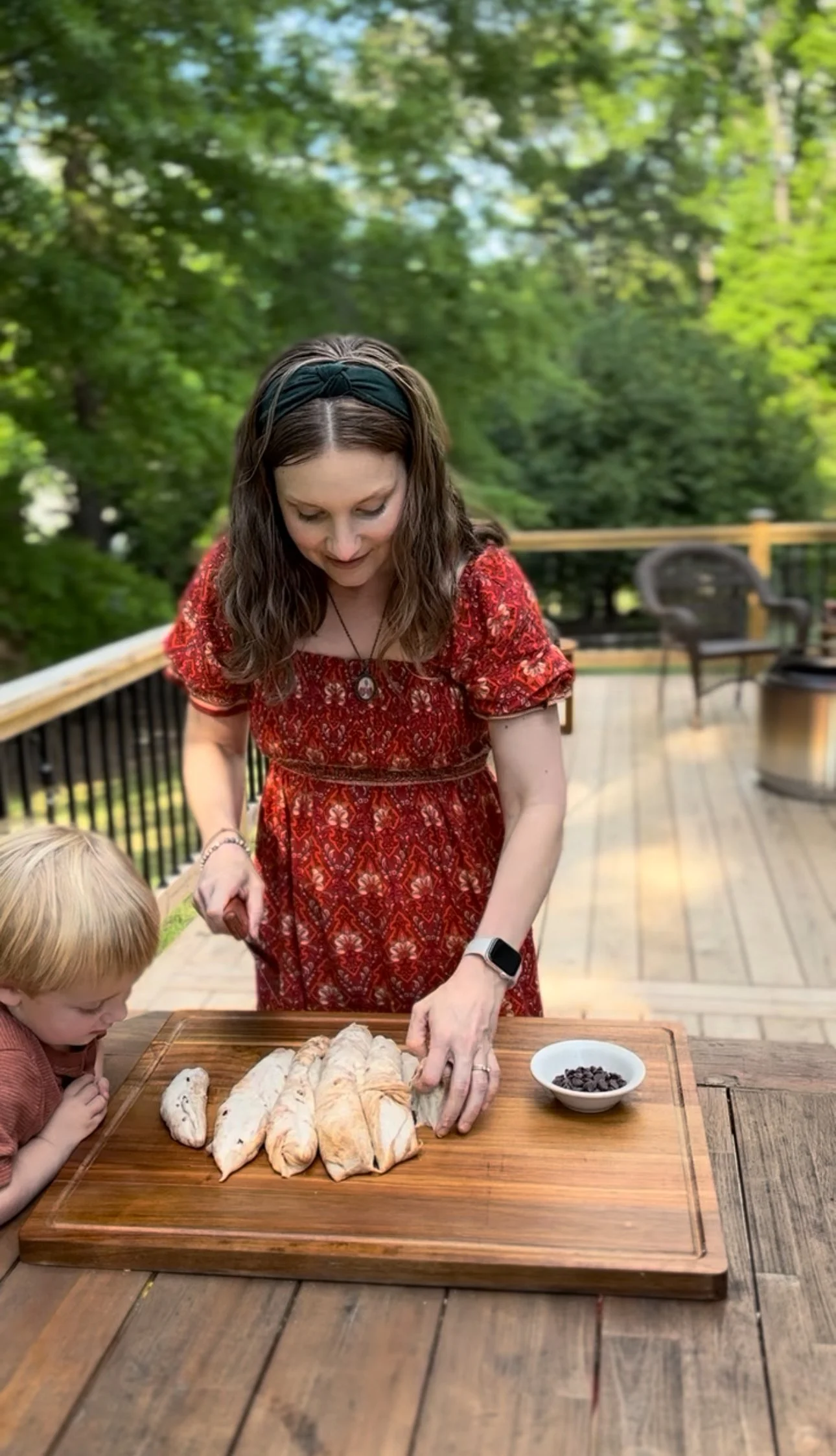
I usually line 2 pans with parchment, set out a bowl of chocolate chips, and demonstrate how to form the buns. To shape the Lazarus buns, first you take egg-sized amount of dough into an oblong shape. Take two little ropes of dough and place them in an x-shape across the middle of the oblong shape. Form a third dough sphere and place it on top of the oblong for the head. Stick two cloves or chocolate chips in the middle of the head for eyes. Some people will use kitchen shears to cut the bottom of the dough to form two legs to show that Lazarus walked, but we have always made them without that.

How we celebrate as a Community
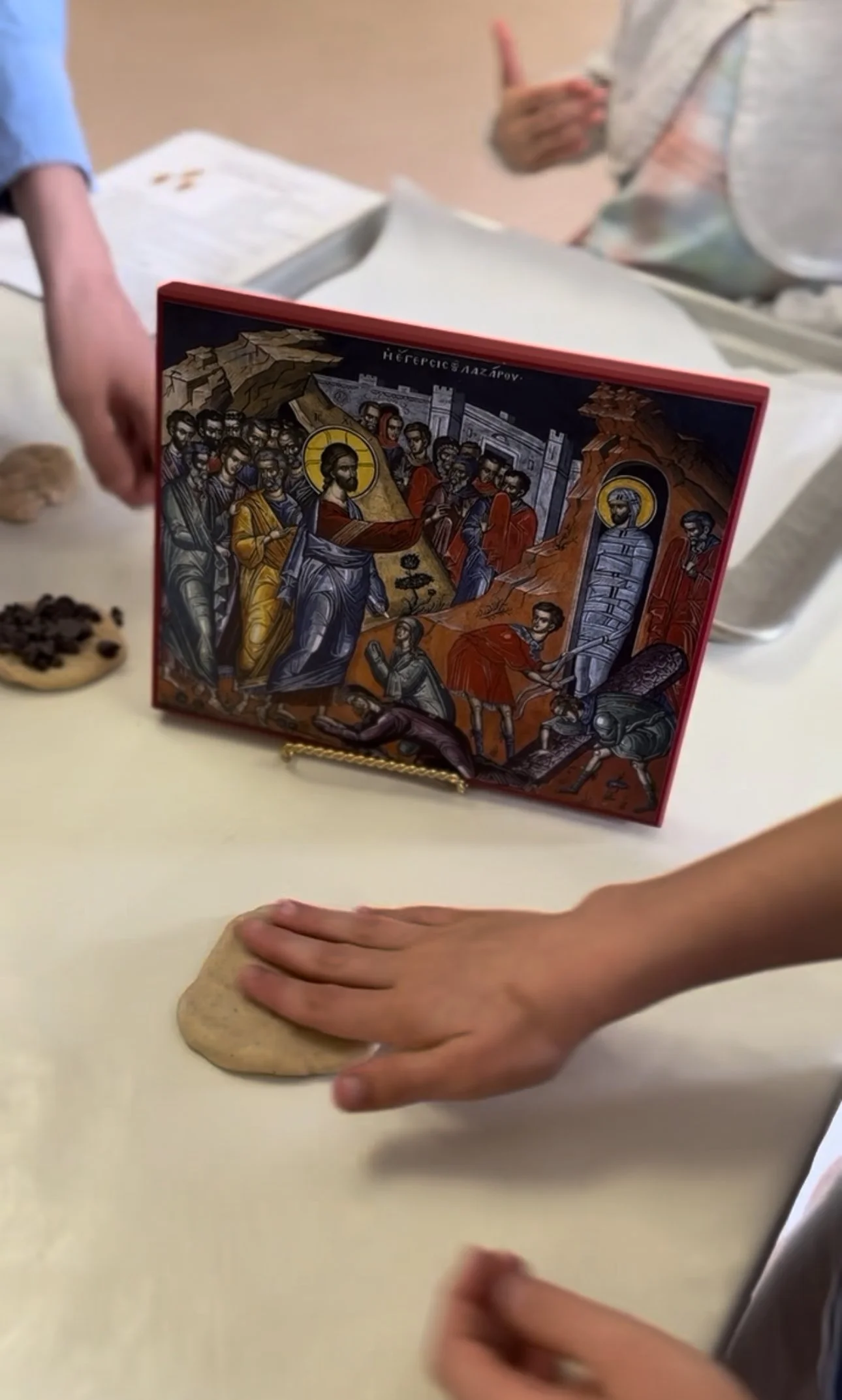
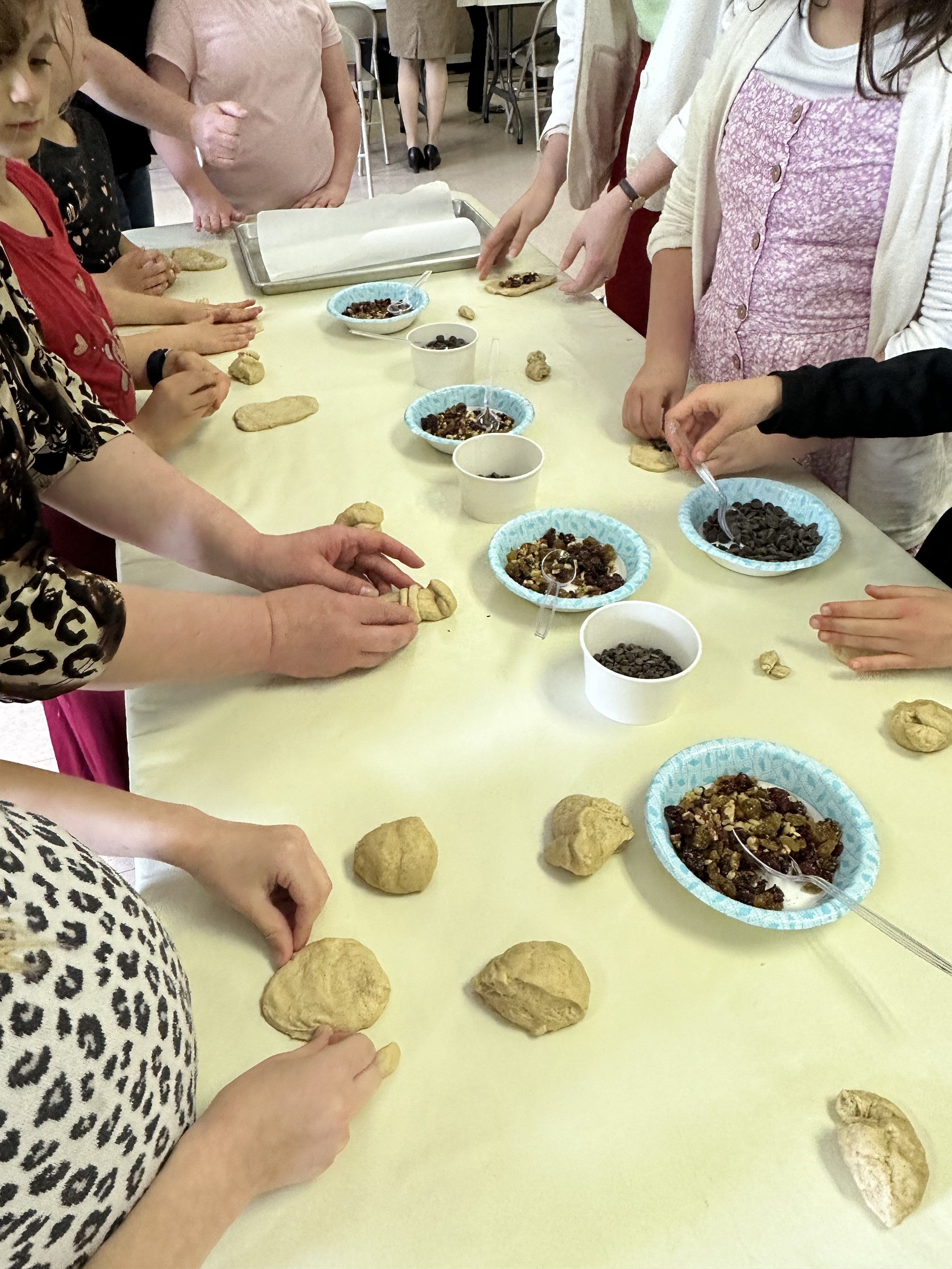
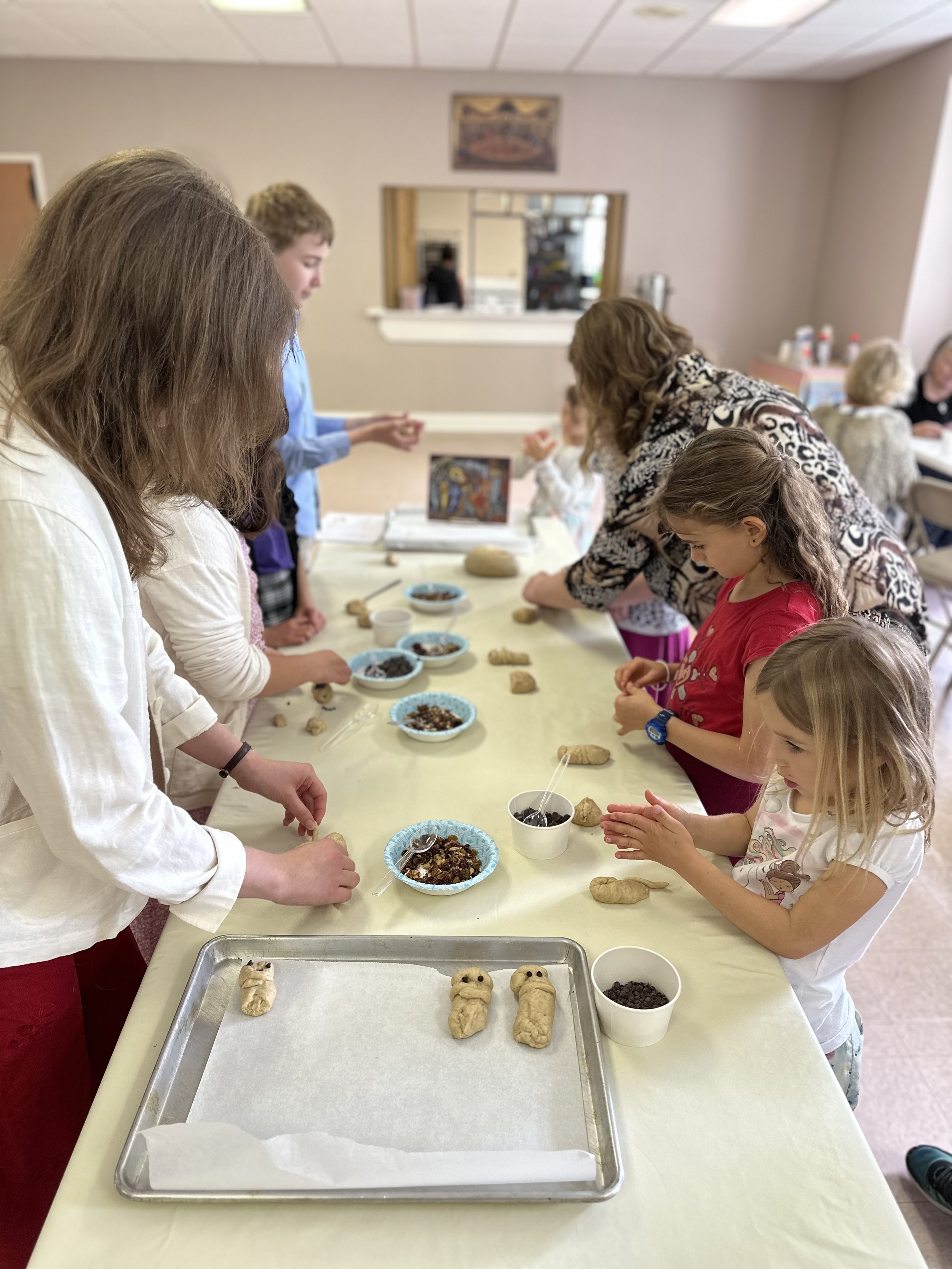
Each year, on Lazarus Saturday, our Church School teachers host a special day for our families. The teachers feed us all lunch after Divine Liturgy and together we fold palm crosses, bake Lazarakia, decorate candles with fresh flowers for Palm Sunday, and the children have the opportunity to sign up for confession with the Priest. It’s a very special day and it kicks off the Holy Week festivities. There is nothing more exciting to me than a bustling full Church! Everyone participates.
Tips for baking Lazarakia as a Church
Have the dough made ahead of time (we use the recipe above and double it to have enough for the kids in our community). Have the ovens pre-heated, and pans prepared with parchment paper. Using a few volunteers, help the kids form the buns, and add their eye toppings. We prefer to use chocolate chips. Last year we had a mixture of walnuts/pecans/cranberries that the kids stuffed in their buns. We tell the story about Lazarus (see below) while they bake and the kids take them home or eat them right there! The fun part is everyone figuring out which one was theirs!
Tell the Story of Lazarus (John 11:1-44)
If you’re unfamiliar with the story, let me share it with you! Lazarus was a man who lived in the town of Bethany with his sisters, Mary and Martha. They were close friends of Jesus. One day, Lazarus became very sick, and his sisters sent a message to Jesus, saying:
“Lord, the one you love is sick.”
But Jesus didn’t go right away. Instead, He said:
“This sickness will not end in death. It is for God’s glory so that God’s Son may be glorified through it.”
Jesus stayed where He was for two more days. Then He told His disciples it was time to go to Bethany. He said something surprising:
“Our friend Lazarus has fallen asleep, but I am going there to wake him up.”
The disciples didn’t understand—so Jesus told them plainly:
“Lazarus is dead.”
By the time Jesus arrived in Bethany, Lazarus had already been in the tomb for four days. Many people had come to comfort Mary and Martha, who were heartbroken.
When Martha saw Jesus, she said:
“Lord, if You had been here, my brother would not have died. But even now, I know that God will give You whatever You ask.”
Jesus told her:
“Your brother will rise again.”
And then He said one of the most powerful things in all of Scripture:
“I am the resurrection and the life. Whoever believes in Me will live, even though he dies; and whoever lives and believes in Me will never die.”
Then Mary came to Jesus, weeping, and others wept too. Jesus was deeply moved. And then:
Jesus wept.
He asked where Lazarus had been laid, and they led Him to the tomb. It was a cave with a stone across the entrance. Jesus told them to roll the stone away. Martha hesitated—after four days, the body would smell—but Jesus reminded her to believe.
They rolled away the stone. Then Jesus looked up to heaven and prayed. And after He prayed, He called out in a loud voice:
“Lazarus, come out!”
And Lazarus came out, his hands and feet wrapped in grave clothes, and a cloth over his face.
Jesus said:
“Unbind him and let him go.”
This miracle showed Jesus’ power over death, and it became one of the final signs before His own Passion, Crucifixion, and Resurrection. It reminds us that Jesus is the source of life and that through Him, death is not the end.
Additional Resources:
Lazarus Saturday Hymn - “Rejoice O Bethany” which is sung on this day is a deeply meaningful and beautiful hymn! Consider playing this a few times on the way to Church or on the way home to help imprint it in your hearts!
Lesson Plan and Paper Puppets by Orthodox Pebbles - Everything you need to share the story of the Lazarus raising from the dead is in this free printable packet! In this lesson you will find an icon worksheet, a cut-and-glue-craft, worksheets to help with the details of the story, symbolism and activities which you can find through this link HERE.
Holy Week Craft Kit by Orthodox Pebbles - The kit contains beautiful printed templates and crafting materials for each day of the Holy Week, from Lazarus Saturday to Pascha Sunday. Everything is bagged up and labeled by day to make it as easy as possible to use. You can purchase this kit through Draw Near Designs HERE.
Dead Man Dead Man, Come Alive Game - My kids inherited this game from their friends, so I don’t know the origin, but this blind fold game can be super fun to play during your Lazarus Saturday festivities. This Youtube video explains how to play!
Book Recommendations:
St Lazarus - Friend of Christ by Potamitis Publishing
For Biblical Stories, we prefer to read them directly from the source! Two of our favorite children’s Bibles are The Children’s Reader Bible (this story is on page 227) and The Picture Bible (page 626) which is illustrated much like a comic book
Final Thoughts
These traditions are not done just for the sake of “traditions” but rather as an interwoven part of our life in Christ. Our hope is that everything we do is to glorify God. Our very lives are a living testament to the life Christ has given us. We share in these traditions because we love Christ, and we love His saints! These traditions help strengthen our family bonds, and help us connect across generations and across cultures around the world, reminding us that we are apart of a greater body of Christ- the Church! These hands on activities are especially engaging for children and create excitment and joy in our lives in Christ.
Whatever you do, I pray it’s a blessing for you and your family!
-Khouria Destinie